Two years ago, the question was whether Amazon was really serious about travel. Now the question is narrower: is Amazon serious about selling trips, or about controlling which trips you see?
Back in November 2024, “getting into travel” meant a handful of travel brands showing up in Amazon’s Cyber Week deals. It looked like marketplace opportunism, not strategy. Since then, two developments point otherwise: Alexa+ expanding into voice-led travel planning (reported by Skift in April 2026), and a May 2026 move that answers the question I keep asking myself about Amazon’s role in travel.
The Models Don’t Matter Anymore. That’s the Point.
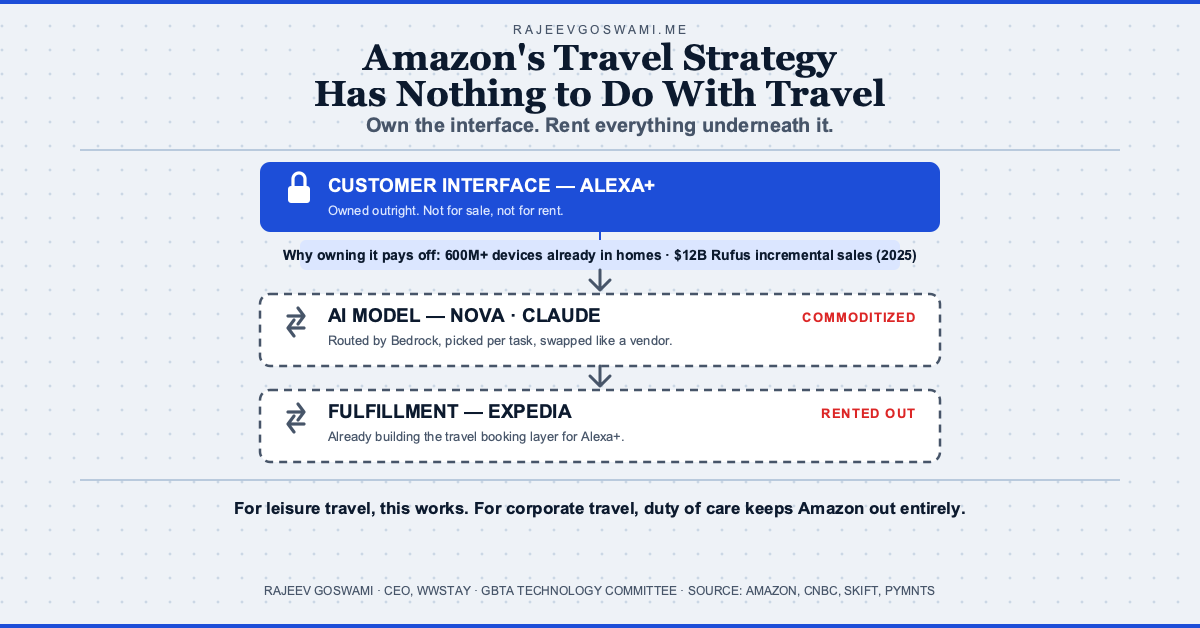
Alexa+ runs on Amazon Bedrock, which routes each request to whichever model handles it best. For example, it uses Nova for speed and Anthropic’s Claude for harder reasoning. The point is that the frontier models have become commodity input, picked and swapped like a vendor, not a strategic asset.
That is exactly why Amazon’s real strategy isn’t Alexa’s AI model. It’s everything else that the model can’t replace: 600 million-plus devices already sitting in homes, a live shopping history on every customer, and full control over the checkout. Amazon has quietly blocked ChatGPT’s crawlers from its own site since November 2025. It is fighting Perplexity’s Comet agent in court over the same principle. At the same time, it is investing tens of billions into OpenAI and Anthropic as an infrastructure landlord. It doesn’t need the best model. It needs to be the only one standing between its customers and the transaction.
Amazon Folded Rufus Into Alexa. That’s the Real Signal.
In May 2026, Amazon retired its standalone Rufus shopping chatbot and merged it into “Alexa for Shopping,” combining Alexa+ and a customer’s full purchase history into one agentic surface across the app, browser, and Echo devices. Here’s the evidence: over 300 million users by late 2025 and $12 billion in incremental annualized sales, with users 60% more likely to complete a purchase. So Alexa is no longer a side project sitting next to Amazon’s retail business. It is the retail business’s new front door.
Own the Customer, Rent the Fulfillment
This is where Amazon’s travel play becomes clearer. Amazon isn’t trying to become an OTA. It has no interest in negotiating hotel rates, managing inventory, or handling disruption. That is expensive, thin-margin work it has never wanted. What it wants is the same thing it’s building for retail: own the intent, own the relationship, own the moment the customer decides what they want, and let someone else fulfill it.
That is a reasonable model to expect for leisure travel.
A traveler asking Alexa to book a weekend away is a low-stakes, high-frequency, discretionary purchase — this is the kind of transaction Amazon already dominates in retail. Hand over the booking to a partner: Amazon’s own MCP rollout for Alexa+ names Priceline, Viator, and Virgin Atlantic as the first travel companies building end-to-end booking tools on top of it, with Priceline as the flagship early test case. Expedia has a separate, earlier deal to surface its hotel inventory inside Alexa+, but it’s notably absent from this newer, checkout-capable rollout. Either way, Amazon keeps the customer relationship and the data on the front end, and takes a fee on the booking. That’s the intermediary role Amazon has always preferred: no fulfillment risk, and a fee on every transaction anyway.
Corporate travel is different, and I’ve written before about why. Negotiated corporate rates, duty-of-care obligations, policy compliance, and TMC-managed disruption handling are not things a consumer voice assistant is built or licensed to touch.
An AI agent that books outside the managed program creates exactly the leakage and visibility gaps travel managers already worry about. Amazon’s model doesn’t need to solve those problems — it operates outside them entirely. So for corporate travel buyers, this isn’t Amazon versus TMCs. Amazon isn’t even playing that game.
The Template Other Travel Retailers Should Watch
If Amazon pulls this off in leisure, expect the model to get copied fast. Expedia, Booking, and every consumer OTA are watching the same dynamic. Business strategists are already naming this split elsewhere. Bain has told retailers this year to guard their fulfillment, checkout, and customer data before AI agents commoditize them. A recent CIO framework put the same choice more bluntly: own it or rent it. Nobody has mapped that split onto travel yet. Amazon just built the clearest working example of it.
My read is that the winning move for a travel retailer isn’t building a better travel LLM. Instead, control the interface where intent gets captured, let a commoditized model do the reasoning underneath, and treat fulfillment as someone else’s job to fight over. That is what Amazon is doing.
For travel managers and suppliers, the practical takeaway is the same as what you heard before about AI agents in my blogs: whoever controls the interface controls visibility, and, most importantly, who gets to influence the decision in the first place. For your own program, the question is simpler: when a leisure-style AI agent shows up asking to book on your travelers’ behalf too, will your policy even notice?
Rajeev Goswami is CEO of WWStay and a member of the GBTA Technology Committee.
References
- Amazon Q4 2025 Earnings Release — Rufus/Alexa for Shopping figures — About Amazon
- How Amazon Rebuilt Alexa With Generative AI — About Amazon
- Amazon Says That Alexa Is Model-Agnostic — TechCrunch
- Amazon Quietly Blocks More of OpenAI’s ChatGPT Web Crawlers From Accessing Its Site — Modern Retail
- Amazon Wins Court Order to Block Perplexity’s AI Shopping Agent — CNBC
- Alexa Plus Learned to Order Pizza. Travel Booking Is Next — Skift
- Alexa Plus Starts with Takeout but Travel Is the Bigger Play — AltexSoft
- Amazon Ditches Rufus Chatbot, Launches Alexa Shopping Agent in AI Strategy Pivot — CNBC
- OpenAI Models Could Help Power Alexa as Part of Amazon Investment Deal — CNBC
- Agentic AI in Retail: How Autonomous Shopping Is Redefining the Customer Journey — Bain & Company
- Own It Or Rent It? A CIO’s Framework For AI Deployment — Forbes Technology Council
- Amazon’s Alexa+ Is Trying to Sell Trips Inside a Chat. Priceline Is an Early Test — Skift

Leave a Reply