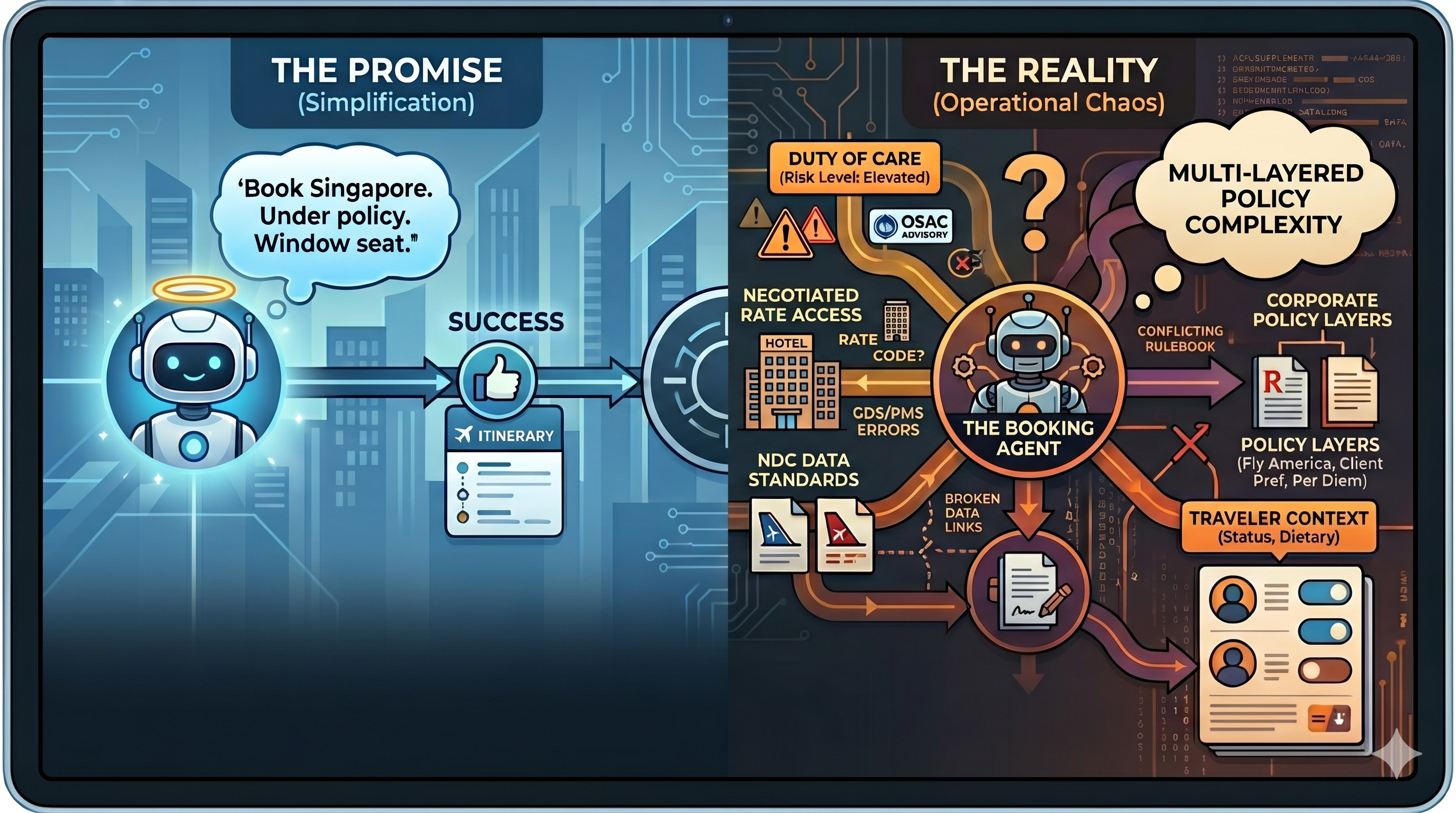
A new vision is taking hold across the corporate travel industry:
A traveler types “I need to fly to Singapore next Tuesday for two nights, under policy,” and an AI agent books the whole trip — optimal fare, approved hotel, ground transport — without a human touching anything.
The signals are hard to ignore. In January 2026, Sabre made a minority investment in BizTrip AI, describing the move to “fostering innovation across the travel ecosystem” — a deliberate effort to recast itself from a legacy GDS into an AI-native, API-driven travel platform. In May 2026, Sabre went further, partnering with Mindtrip and PayPal to launch what they called “travel’s first end-to-end agentic AI booking experience.”
Sabre is not alone—the entire industry seems to be rushing toward the same goal. Survey data backs the momentum: 76% of business travelers already say they trust AI for T&E tasks. The agentic corporate travel revolution, we’re told, is finally here.
I think we’re solving the wrong problem.
Not because agentic AI can’t book a flight. It absolutely can. The technology to parse natural language, query GDS inventory, check against a policy ruleset, and generate a PNR exists today. What the agentic AI evangelists keep glossing over is that in corporate travel, booking has never been the hard part. The hard part is everything that surrounds the booking — and that’s precisely where autonomous agents fall apart. This is the same illusion I picked apart when I looked at why AI won’t kill the corporate booking tool — the technology to plan and search is not the same thing as the technology to safely own a transaction end to end, and corporate travel keeps conflating the two.
The Policy Problem Is Not a Rules Engine Problem
Corporate travel policy sounds simple on paper: book inside the travel management company’s platform, stay within per diem, use preferred suppliers. In practice, it’s a dynamic negotiation between four or five competing authorities. Your company has a preferred hotel program. Your client — if you’re billing back travel — may have their own rate codes and vendors. Your government might require specific carriers on certain routes (the Fly America Act, for instance, still shapes how consulting firms handle federally funded projects). And then there’s the traveler’s own profile: window seat, Marriott Bonvoy status, a dietary restriction that rules out the cheapest hotel’s only restaurant option.
No Travel LLM has yet demonstrated that it can reliably navigate this kind of multi-layered, context-dependent policy without a human in the loop. What most of these platforms are really building — however they brand it — is a better search and retrieval interface. That’s genuinely useful. But calling it “agentic” implies a level of autonomous decision-making that the enterprise compliance environment doesn’t yet support — and arguably shouldn’t.
Duty of Care Isn’t a Feature Flag
Here’s a scenario agentic AI boosters don’t like to discuss: a traveler’s AI agent books a hotel in a neighborhood that a company’s corporate security protocol would flag as elevated risk. The system checked price. It checked availability. It checked loyalty program. It didn’t know about the security advisory, because security advisories aren’t structured data that flows cleanly through GDS feeds or NDC channels.
Duty of care in corporate travel is legally consequential. If a traveler is harmed and the company can’t demonstrate that its booking processes incorporated real-time risk intelligence, it faces liability. Travel managers know this. It’s why even the most automation-enthusiastic TMCs keep human agents on the loop for trips to certain destinations. An AI agent that can’t reliably read an OSAC advisory the same way it reads a fare rule is not ready to own that decision autonomously.
The Rate Leakage Gap Nobody Talks About
The industry has spent a decade fighting the battle over airline NDC (New Distribution Capability) adoption, but it is ignoring a massive, fragmented mess on the hospitality side. The reality of corporate hotel procurement in 2026 is that a company’s negotiated rates don’t live in clean, universally structured AI feeds. Instead, they are buried inside a labyrinth of legacy Central Reservation Systems (CRS), localized Property Management Systems (PMS), and custom corporate rate codes injected manually into a Travel Management Company’s (TMC) mid-office environment. This means that an autonomous AI agent trying to book a hotel room for your road warriors will frequently fail to surface your specific, deeply discounted corporate rate. Lacking the ability to navigate off-channel portals or cross-reference audited hotel databases, the agent will default to the standard BAR (Best Available Rate). The efficiency narrative completely inverts here: your highly advanced AI agent is now actively leaking corporate savings that a seasoned human travel consultant would have flagged and corrected in seconds. This is the exact same GDS-versus-OTA visibility gap I mapped out on the hotel-rate side — the negotiated rate loses whenever the AI can only see the cleaner, structured data, regardless of which corporate travel workflow it’s embedded in.
What Agentic AI Should Actually Do in Corporate Travel
None of this means the agentic AI push in corporate travel is misguided. It means the value proposition needs recalibration. Agentic AI in corporate travel is genuinely powerful for three things: pre-trip research and option generation (surfacing the five best compliant options rather than making the final call), post-trip reconciliation (matching receipts to bookings, flagging exceptions, automating expense coding), and real-time disruption management (rebooking a canceled flight within policy before the traveler even lands).
These are significant time-savers for travel managers and road warriors alike. The companies selling agentic travel AI as end-to-end autonomous booking are overpromising — and the travel managers who buy that promise without asking hard questions about policy depth, duty of care integration, and negotiated rate access will find out the hard way.
Notably, Sabre’s own executive said it best in January 2026: “This is augmentation, not displacement.” That framing is exactly right — and it’s telling that the candid internal view is more measured than the external press narrative. Even the Mindtrip/PayPal agentic booking experience launched in May is built for consumers making leisure decisions, not a procurement officer managing 500 road warriors across negotiated supplier agreements. The use cases are genuinely different, and the industry would do itself a favor by being more precise about which problem it’s actually solving.
The best AI travel agents won’t replace the human judgment in corporate travel. They’ll handle the thirty minutes of look-up work that precedes that judgment. That’s less exciting to put in a press release. But it’s what will actually get adopted at scale.
References
- Sabre and BizTrip AI Announce Strategic Partnership — Sabre Investor Relations, Jan 2026
- Sabre’s Agentic AI Travel Booking Tool Launches on Mindtrip — Skift, May 2026
- Sabre Exec: ‘This Is Augmentation, Not Displacement’ — Skift, Jan 2026
Rajeev Goswami is CEO of WWStay and a member of the GBTA Technology Committee.

Leave a Reply