Why It’s Killing Your Project Margins
When an enterprise wins a massive consulting contract, kicks off a 6-week regional system integration, or deploys an audit team to a major hub, the Project Management Office (PMO) maps out the timelines perfectly. Deliberate milestones are set. Budgets are locked down. The operational spreadsheet balances beautifully.
But three weeks into the deployment, momentum begins to stall. Deliverables get delayed. Key engineers or consultants look visibly exhausted, and rumors of burnout ripple through the team.
What went wrong? The project parameters didn’t change, and the budget was followed to the penny.
The failure wasn’t programmatic; it was foundational. It was the result of invisible friction—the unquantifiable, micro-stressors of mid-duration project travel that standard corporate booking infrastructure completely fails to capture.
The CBT Optimization Illusion
The root of the problem lies in a category classification error. Most Corporate Booking Tools (CBTs) run on legacy Global Distribution Systems (GDS) engineered decades ago for quick, transient nightly transactions—like a 2-day flight or a standard weekend hotel stay.
When a project team requires a 45-day stay, this legacy infrastructure forces an incredibly subpar choice. And if you think your organization doesn’t default to standard hotels for long stays, the industry data exposes a massive gap between procurement intent and reality:
- The 71.6% Default: Research indicates that an astronomical 71.6% of global business travelers are still routed into traditional, standard hotels—even as their length of stay stretches into multi-week commitments.
- The 60% Program Leakage Rate: When corporate travel policies fail to offer specialized, integrated extended-stay options, employees take matters into their own hands. A landmark study conducted by the Global Business Travel Association (GBTA) in partnership with WWStay revealed that 60% of business travelers who require extended accommodations end up booking them entirely on their own, outside of their approved corporate travel channels.
- The Content Gap Multiplier: Recent 2026 data from Trip.Biz confirms that this behavior isn’t an employee compliance issue; it’s an infrastructure problem. Nearly one-third of companies report that 20% or more of their total travel spend leaks outside the approved platform, with 53% explicitly citing missing content as the primary driver for booking outside corporate channels. Furthermore, data from HRS demonstrates that extended-stay lodging suffers from a leakage rate that is 2x higher than the overall corporate program average, driven by a structural lack of suitable properties within legacy systems.
When faced with multi-week project deployments, legacy workflows force procurement into two highly inefficient paths:
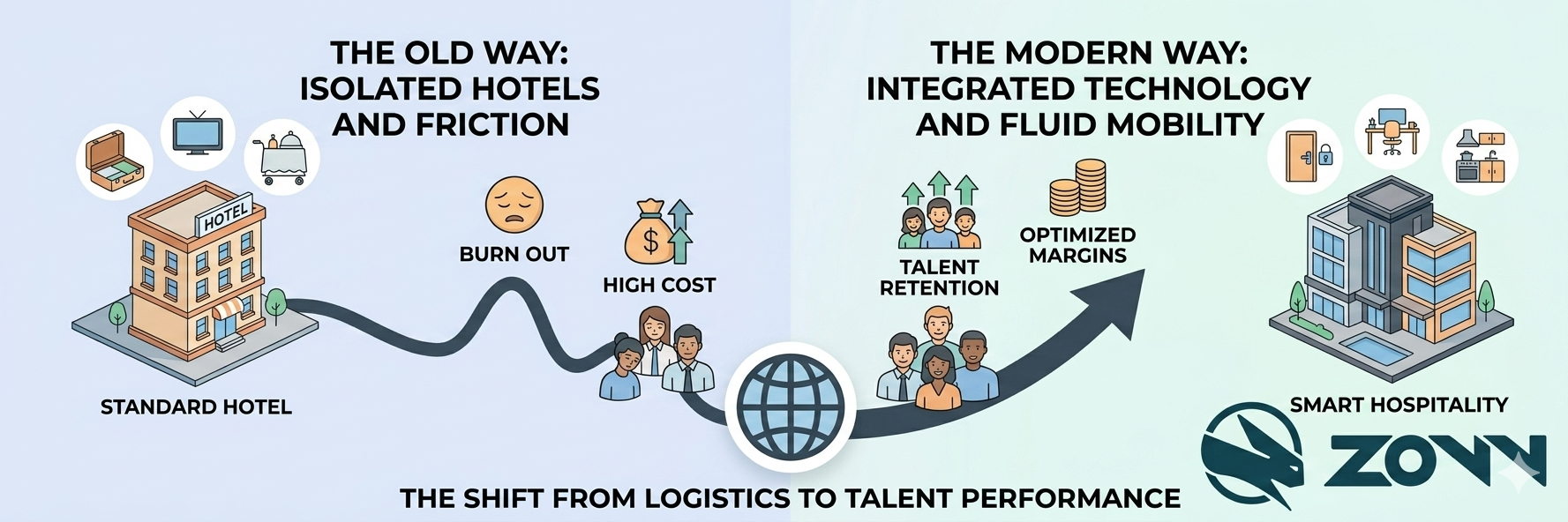
- The Standard Hotel Trap: Booking a high-value consultant into a 300-square-foot standard hotel room for six weeks straight. There is no kitchen, no physical separation between the workspace and the rest space, and zero routine. Living out of a suitcase for a month isn’t a premium corporate perk; it is an active recipe for cognitive decline and burnout.
- The Fragmented Offline Sourcing Nightmare: Desperate project managers attempting to bypass rigid company software to source local, unvetted alternative accommodations manually. This triggers an avalanche of manual offline workflows, credit card authorization forms, massive data leakage, and compliance vulnerabilities. This is the exact same offline-sourcing trap I described in an earlier post on project accommodations — the workaround hasn’t gone away in the two years since, it has just gotten more expensive as project durations have stretched.
Procurement managers look at the negotiated corporate nightly rate at a preferred hotel chain and celebrate a paper victory. What they completely fail to track are the massive, compounding “soft costs” that follow: expense reports overflowing with 45 days of hotel laundry and room service, combined with diminished human performance on a high-stakes client deployment.
Project Travel is an Operational Variable, Not an HR Edge Case
We need to shift how we view mid-duration corporate mobility. Sourcing housing for an embedded tech team or a consulting unit isn’t a centralized HR policy or a standard travel expense. It is a direct operational variable affecting your project’s Gross Margin.
When you displace your best technical or strategic minds, their mental overhead skyrockets. If they are spending their evenings navigating basic living logistics—or feeling trapped inside a clinical hotel environment—they are not operating at peak cognitive capacity for the client.
Modern project teams don’t want hotel room service; they want residential autonomy. They need seamless, digital-first booking fluidity that mirrors their consumer tech apps, combined with local stability.
Fixing the Booking Infrastructure Layer
To eliminate the invisible friction hobbling your project delivery, enterprises don’t need to change where their teams stay—they need to change how that inventory is aggregated and procured.
The answer is not a manual corporate housing agency. The answer is a specialized, modern booking engine that handles extended-stay data at scale.
By integrating a specialized technology layer capable of ingesting, normalizing, and verifying global extended-stay and serviced apartment inventory, the enterprise solves the structural data fragmentation problem. According to Trip.Biz’s 2026 findings, 91% of travel managers acknowledge that incomplete trip capture directly damages their ability to manage duty of care, risk monitoring, and financial compliance.
When you fix the data pipeline via an advanced booking engine, project managers get instant, automated compliance and transparent tracking. Simultaneously, deployment teams get the localized, friction-free environments they need to deliver high-value outcomes. This same rate-versus-governance tension shows up on the pricing side too — it’s the same structural argument I make about hotel RFPs needing to shift from static annual negotiation to dynamic rate governance.
Next time you review an upcoming project deployment budget, look past the basic hotel RFP rates. Look at the structural friction built into your corporate booking software.
Rajeev Goswami is CEO of WWStay and a member of the GBTA Technology Committee.

Leave a Reply