For years, sustainability sat on the edge of most corporate travel programs.
The ESG team owned it. The sustainability officer reported on it. Travel supplied a few numbers, answered occasional questions, and moved on.
That arrangement is ending.
Business travel emissions are increasingly becoming part of formal corporate reporting processes. Regulatory developments in Europe and the United States are accelerating that shift, but the bigger story isn’t regulation.
It’s accountability.
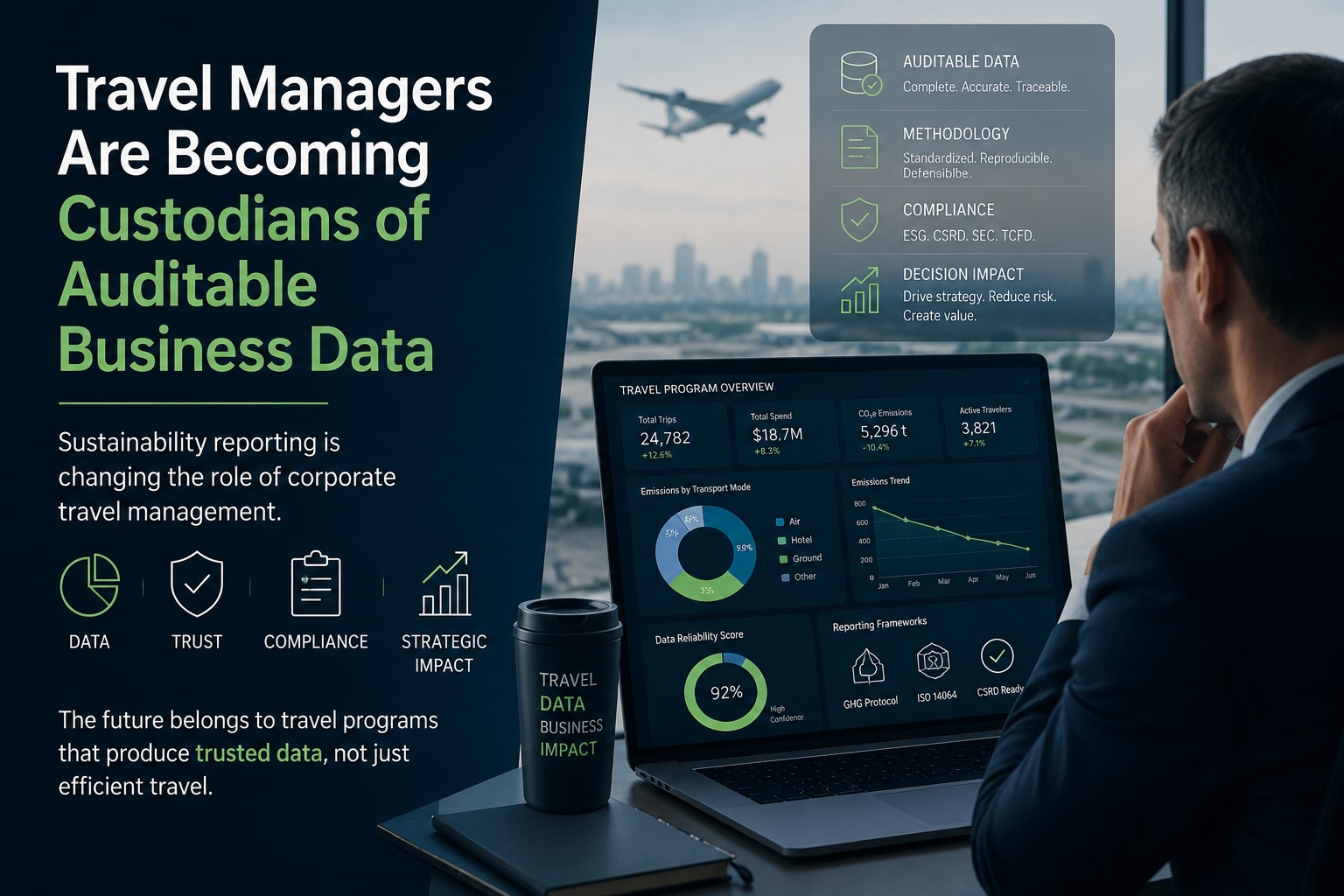
Travel managers are becoming stewards of operational data that may ultimately be reviewed, challenged, and relied upon by executives, auditors, investors, regulators, and customers.
That represents one of the most significant changes to the travel management profession in the past decade.
Sustainability Is Moving Closer to Operations
The European Union’s Corporate Sustainability Reporting Directive (CSRD) requires many companies operating in Europe to disclose material sustainability information, including Scope 3 emissions categories such as business travel.
In the United States, California’s SB 253 Climate Corporate Data Accountability Act is creating similar momentum around emissions reporting for large companies doing business in the state.
Implementation timelines and reporting thresholds continue to evolve, but the direction is clear: environmental reporting is becoming more structured, more transparent, and increasingly subject to assurance and governance requirements.
For travel managers, that means the data generated through booking tools, TMCs, expense systems, and supplier feeds is no longer just operational information.
It is becoming part of a broader corporate reporting framework.
The Data Gap Few Travel Programs Have Addressed
Most travel programs today can produce an annual estimate of business travel emissions.
Far fewer can explain exactly how that number was calculated.
Organizations increasingly need to demonstrate:
- Data completeness
- Consistent methodologies
- Documented assumptions
- Traceability back to source transactions
- Clear governance over how emissions are calculated and reported
The question is no longer simply: “Can you produce a carbon number?”
The question is becoming: “Can you explain and defend it?” This is the same defensibility test I raised when I looked at duty of care in multilingual AI travel systems — a number or a translation that can’t be traced back to its source isn’t governance, it’s a guess with a nice interface.
Travel Managers Are Closer to the Data Than Anyone Else
The underlying data doesn’t live in sustainability systems.
It lives inside travel operations.
Booking channels. TMC data feeds. Expense systems. Corporate card programs. Supplier reporting platforms.
The travel manager sits closer to those data sources than almost anyone else in the organization.
Historically, travel managers have been measured on:
- Cost control
- Policy compliance
- Traveler experience
- Supplier performance
- Duty of care
But an additional responsibility is emerging: ensuring the integrity and usability of travel data for broader business purposes.
Why This Matters Beyond Sustainability
Many travel managers may view carbon reporting as simply another compliance requirement.
That would be a mistake.
The real significance of this shift is not environmental reporting itself. It is the growing recognition that travel data has become a strategic business asset.
Consider how corporate travel data is increasingly being used today. Finance teams use it to understand project profitability and cost allocation. Procurement teams use it to evaluate supplier performance and negotiate agreements. Risk teams rely on it for traveler tracking and duty-of-care obligations. Sustainability teams depend on it for emissions reporting and ESG disclosures.
Increasingly, executives are asking a broader question:
Can we trust the data behind our decisions?
That question extends far beyond carbon reporting.
The organizations that establish strong governance around travel data today will be better positioned to support future requirements, whether they involve sustainability disclosures, workforce mobility reporting, supplier diversity initiatives, AI-driven decision support, or regulatory compliance.
In many ways, carbon reporting is simply the first test. This is a similar verification gap to the one hotels face with their own AI-readiness claims — nobody has yet built the equivalent of an audit standard, so buyers on both sides are left taking vendor claims at face value.
The larger transformation is that travel programs are evolving from transaction management platforms into sources of operational intelligence.
Travel managers who recognize this shift early will have an opportunity to elevate their role within the organization. Those who continue to view travel data solely as a reporting output may find themselves struggling to meet the expectations being placed on modern travel programs.
The future value of a corporate travel management program will not be measured only by how efficiently it moves travelers.
It will increasingly be measured by the quality, reliability, and business value of the data it generates.
The Next 12 Months: Three Practical Priorities
1. Assess Data Completeness
Understand where travel data originates and where gaps exist.
2. Review Reporting Methodology
Know which emissions methodology is being used, who owns it, and how often it is updated.
3. Strengthen Internal Partnerships
Travel, procurement, finance, ESG, and risk teams increasingly depend on the same underlying data.
A New Definition of Travel Management
Travel managers are increasingly becoming custodians of operational intelligence that influences financial decisions, sustainability disclosures, workforce planning, and corporate governance.
The most successful travel programs of the next decade will not simply move people.
They will generate trusted data.
Note
This article reflects the author’s interpretation of emerging trends in corporate travel, sustainability reporting, and operational governance. Companies should consult legal, accounting, sustainability, and compliance professionals regarding specific reporting obligations.
References
- European Commission — CSRD
- ESRS E1
- California SB 253
- The EU’s CSRD: What travel managers need to know — FCM Travel
- Deloitte — Sustainability Reporting
- PwC — Climate Disclosure Requirements
- KPMG — ESG Reporting Trends
Rajeev Goswami is CEO of WWStay and a member of the GBTA Technology Committee.

Leave a Reply