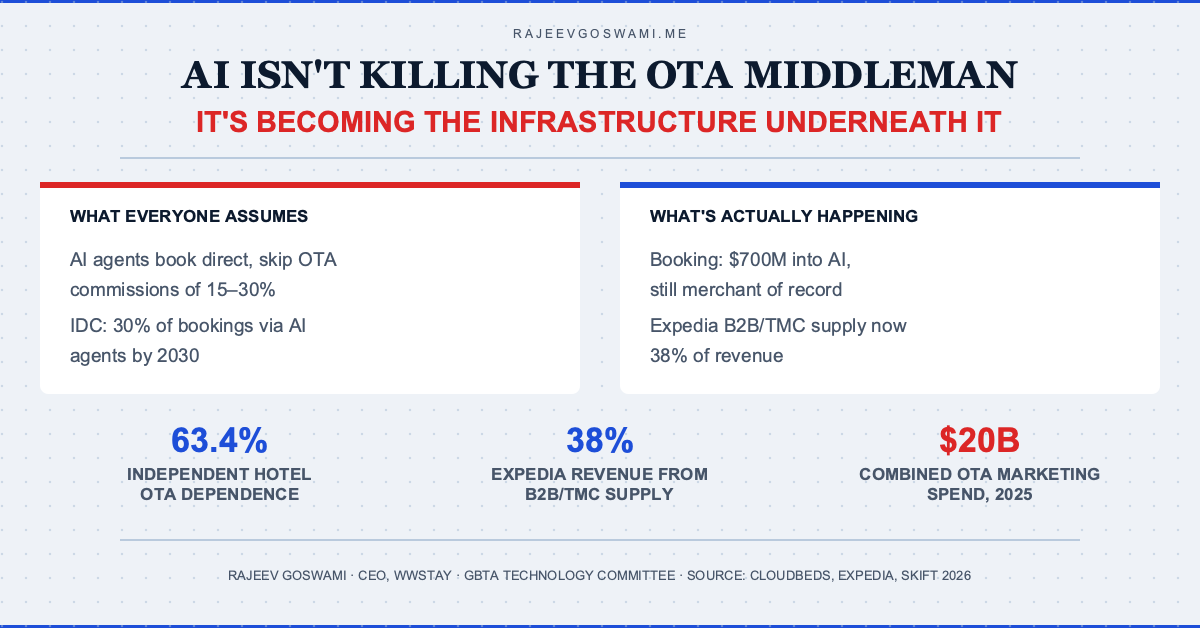
Cloudbeds’ fourth annual State of Independent Hotels Report found something stark this year: independent hotels’ RevPAR fell 5.4% in 2025 while OTA dependence climbed to 63.4% of bookings. Nearly every travel conference panel frames the fix as the same story — AI disintermediation is coming for the OTA middleman, and hotels that get “AI-eligible” now will win back ground OTAs took over two decades.
For travel managers, that story should prompt a sharper question, not comfort: who actually owns the transaction once the “middleman” supposedly disappears? The 2026 evidence says the popular narrative has it backwards. OTAs aren’t being cut out of AI-driven travel — they’re positioning as the infrastructure underneath it, and their fastest-growing business line never shows up on a channel-mix report.
What the “AI Disintermediation” Story Actually Claims
The pitch is plausible: agentic AI — ChatGPT, Gemini, Perplexity, hotel-native assistants — will let travelers book directly, skipping OTA commissions of 15–30%. IDC projects 30% of travel bookings will run through AI agents by 2030; Priceline relaunched Penny as a 10-plus-agent system, and Sabre, PayPal, and Mindtrip shipped an agentic booking pipeline. The implicit promise to hotels: make your data AI-readable and the AI layer becomes a new direct channel, cutting the intermediary out.
Clean story. It isn’t what’s happening in 2026.
Why Travel Managers Need to Ask a Sharper Question
In March 2026, OpenAI quietly pulled ChatGPT’s native checkout — only about 30 Shopify merchants had gone live before it was shelved into third-party apps. TD Cowen called the retreat a “stunning admission” that AI-as-commerce-layer is stalled.
The mechanism: even when an AI agent pulls live inventory from Booking.com or Expedia’s API rather than sending a traveler to their website, those platforms remain merchant of record and still collect commission.
One hospitality analysis calls this the “disintermediation paradox” — AI removes the visible storefront, not the infrastructure behind it. The real question isn’t “will AI kill the OTA” — it’s which layer of the booking stack your program controls. Right now, probably not much.
Where the Real OTA Advantage Actually Lives
Booking and Expedia aren’t reacting defensively here — they’re funding their way in. Booking committed roughly $700 million in 2026 reinvestment toward generative AI and its “Connected Trip” platform, accepting a near-term EBITDA hit to do it.
CEO Glenn Fogel confirmed in April that Booking works directly with OpenAI and Google to keep its supply discoverable wherever a traveler’s AI conversation starts.
Expedia CEO Ariane Gorin made the complementary point in May: AI is a discovery layer, but booking and servicing still need “a trusted, scaled provider.” She called AI-driven paid placement a net positive for Expedia. The four largest OTAs crossed $20 billion in combined marketing spend in 2025 alone, up from $17.8 billion the year before.
AI eligibility doesn’t level this field. It extends a two-decade data and marketing advantage into a new discovery channel — free of charge.
The Supply Problem Hiding Inside a “Flat” Channel Mix
Here’s what makes this dangerous for corporate programs: Expedia’s B2B segment — the part powering other companies’ booking tools, not Expedia.com — grew gross bookings 24% year-over-year in Q4 2025, versus 5% for its consumer business, and now represents 38% of total revenue.
That growth continued through Q2 2026 — B2B revenue rose 23% year-over-year to $1.39 billion, with gross bookings up 21% to $10.7 billion, versus 8% growth on the consumer side. That traces to arrangements like Expedia’s 2021 sale of Egencia to Amex GBT, bundled with a 10-year hotel-supply agreement that survived Long Lake’s $6.3 billion take-private of Amex GBT untouched.
Branded chains’ headline OTA channel share, meanwhile, has barely moved in a decade — Hilton’s “Stop Clicking Around” campaign spent close to $100 million in 2016, and the split looks roughly the same today. Read only the channel-mix chart and it looks like a stalemate. It isn’t.
OTAs moved their growth engine into B2B supply that never appears on that chart — including inside the TMC platforms travel managers already trust.
My Take
I’ve spent later part of my career on the hotel and corporate-housing side of this industry rather than airline distribution, and this pattern looks familiar to me: an intermediary layer everyone assumes technology will finally remove, quietly re-embedding itself one level deeper instead.
My read on where this goes next: hotels won’t meaningfully resist the OTA growth engine described above, at least not on today’s evidence. A decade of “book direct” campaigns barely moved channel share, and AI-eligibility work is, so far, extending the same OTA advantage rather than displacing it.
That means distribution-driven margin pressure isn’t going away — if anything it compounds, since OTAs are now using AI to defend and grow the exact supply position hotels can’t dislodge.
That pressure has to land somewhere, and the obvious place is the cost side: expect hotels, independents especially, to lean harder into AI for labor and operations, since that’s the one margin lever distribution economics hasn’t already claimed.
Corporate travel programs are better placed to see this coming than most, for a reason worth naming: business travel is adopting agentic AI faster than leisure precisely because corporate programs already have the audit trails and policy guardrails leisure travelers don’t — only 2% of leisure travelers will let AI book for them autonomously.
That instinct for oversight shouldn’t stop at the booking tool. If your OTA content sits inside your TMC’s platform today, ask a blunter question before your next renewal: is AI actually removing that dependency, or just making it harder to see?
References
- Cloudbeds’ 2026 State of Independent Hotels Report — Hospitality Net
- Priceline’s Penny Goes Fully Agentic — Priceline Press Center
- AI Travel Agents Pack a Threat for Travel Aggregators — PYMNTS
- Why OpenAI’s Checkout Retreat Spells Trouble For Its Commerce Strategy — Forbes
- Booking (BKNG) Q4 2025 Earnings Call Transcript — The Motley Fool
- Expedia’s B2B Expansion Accelerates: A Scalable Growth Lever Ahead? — Yahoo Finance
- Expedia Group 2025 Annual Report (Egencia / Amex GBT lodging supply agreement)
- Expedia Group (EXPE): From Tech Unification to B2B Powerhouse — 2026 Research Feature
- Hotels Barely Moved OTA Share in a Decade — Hospitality.today
- Travel Brands Are Building AI Agents for a Consumer That Doesn’t Exist — Skift
- OpenAI’s first crack at online shopping stumbled. It’s preparing for the next wave
- Expedia Group Q2 2026 earnings — PAX News

Leave a Reply