On 28 October, the FTC ordered nine companies to explain how they use personal data to set customer prices and worker pay. Delta, United and JetBlue are on the list. So are Lyft, Uber, DoorDash, Instacart, Target and Walmart. No hotel company is.
However, the FTC’s proposed policy statement from August uses a hotel as one of its examples of personal-data pricing. So this is a reason to start asking questions.
A study, not an enforcement action
The orders ask for information. They do not allege a violation. The FTC says its 2024 study “learned nothing about actual pricing decisions,” so this round asks the companies directly. Each recipient has 45 days from receiving its order to respond, so most deadlines should fall in mid-December.
The issue regulators are focused on
The FTC’s proposed policy statement, issued 19 August, accepts that prices vary when supply and demand change for everyone in the same market. What concerns the FTC is personalized pricing without clear disclosure, which it says could count as an unfair or deceptive practice.
One example in the statement is a hotel that charges more because personal data suggests a guest is “traveling for a funeral or some other can’t-miss personal business.” The FTC says the examples are for discussion only. It also concedes that it cannot ban personalized pricing in every case.
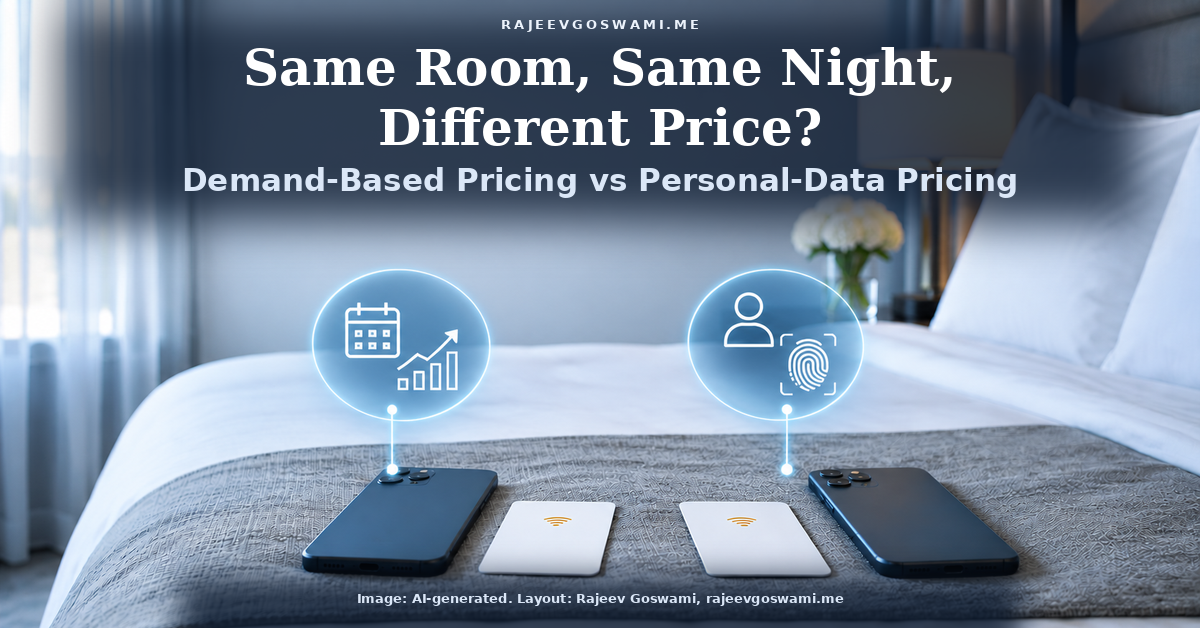
So the issue is not dynamic versus static pricing. It is a price that moves with demand versus one that moves with you. I keep coming back to that distinction because travelers cannot see which one they are looking at.
The states are not waiting
On 27 January, California’s attorney general sent inquiries to businesses in the retail, grocery and hotel sectors as part of a surveillance pricing sweep.
New York has required a disclosure since November 2025: “THIS PRICE WAS SET BY AN ALGORITHM USING YOUR PERSONAL DATA.” Its legislature also passed a surveillance pricing bill on 4 June, although as of 11 November it had not been signed.
Maryland’s law, in force since 1 October, bars large food retailers from using personal data to set a higher price for a single shopper. Loyalty programs that any consumer may voluntarily join are exempt. A broader rule requires a merchant that sets a price using personal data to disclose that at the price.
Connecticut, New Jersey and Seattle follow with their own rules in 2027.
These rules differ. A travel program that spans many jurisdictions cannot assume one answer. So ask suppliers how they handle disclosure across the states your travelers visit.
Travel is not groceries
My view is that travel should not be judged by retail rules, because travel prices have long moved with demand.
Airlines change prices constantly. In 2022, ATPCO, the airline fare-filing system, reported 12 million daily changes to its database. Fodor’s also reports that airlines file fares multiple times a day.
A hotel room is perishable too. A hotel may change its rate once or twice a day.
Maryland’s law recognizes the difference. It exempts price differences driven by supply, availability and location.
Federal law adds another difference. The Airline Deregulation Act bars states from enforcing laws “related to a price, route, or service of an air carrier.” Hotels have no such protection. So state rules that regulate hotel pricing may not regulate airline pricing.
What frequent price changes can hide
Here is the catch. The more often prices move, the harder it is to tell demand from personalization. A traveler who sees a different rate than a colleague often cannot find out why.
State laws are uneven, and the FTC’s policy is still only proposed. A travel manager should not wait for legal protection. Insist on disclosure and an audit trail now.
An earlier post, Dynamic Pricing in Corporate Travel: Why It’s Not the Enemy, argued that the risk is unmanaged price swings. The risk here is unexplained price swings.
What to ask your suppliers
Ask four things now:
- Which personal data, if any, do you use to set the rate a traveler sees?
- Within a loyalty tier or corporate program, does every traveler get the same rate?
- Do your search rankings and filters use personal data, and do you disclose that?
- Can you show an audit trail for why two travelers saw different rates?
A related question, whether AI agents can see a negotiated corporate rate at all, is covered in Hotels Are Letting AI Agents Search. Can They See Your Corporate Rate?
The FTC is still studying loyalty-program participation as a pricing factor. The question is whether a rate changes by individual, not by tier.
At WWStay, we display rooms and hotels based on company policy, budget, earlier stays by the traveler or colleagues, and traveler preferences such as smoking or pet-friendly rooms. Travelers from one company pay the same rate for a given room on a given night.
That is our practice, not a legal conclusion. It is not yet clear whether regulators count ranking and filtering by such data as personalized pricing.
I would rather my suppliers answered these questions before a regulator looks into it.
References
- FTC press release, “FTC Launches Personalized Pricing and Compensation Inquiry,” 28 October 2026: https://www.ftc.gov/news-events/news/press-releases/2026/10/ftc-launches-personalized-pricing-compensation-inquiry
- FTC, Proposed Enforcement Policy Statement Regarding Personalized Pricing, 19 August 2026: https://www.ftc.gov/legal-library/browse/federal-trade-commissions-proposed-enforcement-policy-statement-regarding-personalized-pricing
- Holland & Knight (law firm analysis), “FTC’s Section 6(b) Orders on Personalized Pricing and Pay,” 2 November 2026: https://www.hklaw.com/en/insights/publications/2026/11/ftcs-section-6b-orders-on-personalized-pricing-and-pay-what-businesses
- California Attorney General, Data Privacy Day announcement, 27 January 2026: https://oag.ca.gov/news/press-releases/data-privacy-day-attorney-general-bonta-focuses-surveillance-pricing-compliance
- Jones Day (law firm analysis), “New York’s Novel Algorithmic Pricing Disclosure Law Takes Effect,” November 2025: https://www.jonesday.com/en/insights/2025/11/new-yorks-novel-algorithmic-pricing-disclosure-law-takes-effect
- New York Senate S8623B and Assembly A9349B legislative record, status as read 11 November 2026: https://www.nysenate.gov/legislation/bills/2025/S8623/amendment/B
- Maryland General Assembly, HB 895 (2026), Chapter 154: https://mgaleg.maryland.gov/mgawebsite/Legislation/Details/hb0895?ys=2026RS
- Arnold & Porter (law firm analysis), “All Eyes on Personalized Pricing,” 8 September 2026 (Connecticut and New Jersey laws): https://www.arnoldporter.com/en/perspectives/advisories/2026/09/all-eyes-on-personalized-pricing-what-stakeholders-need-to-know
- Travel Weekly, “Airlines have made strides in dynamic pricing,” reporting ATPCO’s Elevate 2022 conference: https://www.travelweekly.com/Travel-News/Airline-News/Airlines-strides-dynamic-pricing
- Fodor’s, “Why Are Airfares So Different From Day to Day?” (undated): https://www.fodors.com/news/airlines/why-do-airfare-prices-change-so-much
- Hospitality Net, “How to Price a Hotel Room” (consultant contribution), 25 July 2023: https://www.hospitalitynet.org/news/4117447/how-to-price-a-hotel-room
- Congressional Research Service, “The Airline Deregulation Act of 1978: Preemption of State Law,” LSB11493, 21 October 2026: https://www.everycrsreport.com/reports/LSB11493.html
Rajeev Goswami is CEO of WWStay and a member of the GBTA Technology Committee.

Leave a Reply