On June 23, Expedia published global research covering 1,500 hotel decision-makers and named its next strategic move: Autonomous Distribution — a three-phase plan to run a hotel’s pricing, availability, and promotional strategy on autopilot. The headline: fully connected hotels drive better revenue. The subtext: hand us the controls. Industry coverage treated this as a hotel story. For corporate travel managers, the implications are more consequential than that framing suggests.
What Expedia Is Actually Proposing
Full connectivity means integrating a hotel’s core operational systems — reservations, distribution, and payments — so data flows automatically with no manual rate-loading. Until now, a revenue manager adjusted rates periodically based on demand signals. Under Autonomous Optimization, Expedia’s algorithm reprices inventory continuously in real time. The friction is visible in Expedia’s own data: 32% of hotel decision-makers cited fear of losing pricing control as the top reason they hadn’t adopted connectivity software. Expedia’s answer is to ask them to get over it. For corporate travel, the implications are more indirect than they first appear.
Why Corporate Travel Managers Need to Ask a Specific Question
Expedia sold Egencia to Amex GBT in November 2021 — which looks like a clean exit from managed travel. It was not. The deal included a 10-year lodging supply agreement: Amex GBT’s hotel bookings still flow through Expedia’s inventory, and Expedia holds a 16% voting stake and a board seat in the world’s largest TMC. Amex GBT integrates Expedia content into its hotel marketplace, and modern OBTs — Spotnana, Navan, TravelPerk — pull Expedia inventory alongside GDS feeds as standard. Expedia did not leave corporate travel. It restructured its position within it.
The real question is whether Autonomous Distribution directly threatens negotiated hotel programme economics. The answer is more nuanced than the headlines allow.
Where Corporate Rates Actually Live
Corporate negotiated rates are loaded into the GDS — the primary channel through which TMCs and OBTs surface preferred programme inventory. Expedia’s Autonomous Distribution operates on its own platform and does not touch GDS-loaded rate tiers. If the algorithm drives a hotel’s published rate down to win an OTA booking, the negotiated rate in the Amadeus, Sabre, or Travelport feed does not move. Hotels will continue loading programme rates on GDS separately. The direct threat is not as immediate as it first appears — but that is not the right place to end the analysis.
The Compliance Problem Hotels Are About to Make Worse
This is where the damage actually lands. Hotel programme compliance sits at 69% — the worst category in managed travel by a wide margin; air runs 80–100% in well-managed programmes (Deloitte 2025 Corporate Travel Study). Out-of-policy bookings cost 14.7% of total travel spend, and 62.9% of US companies with a written travel policy have no enforcement data to show for it.
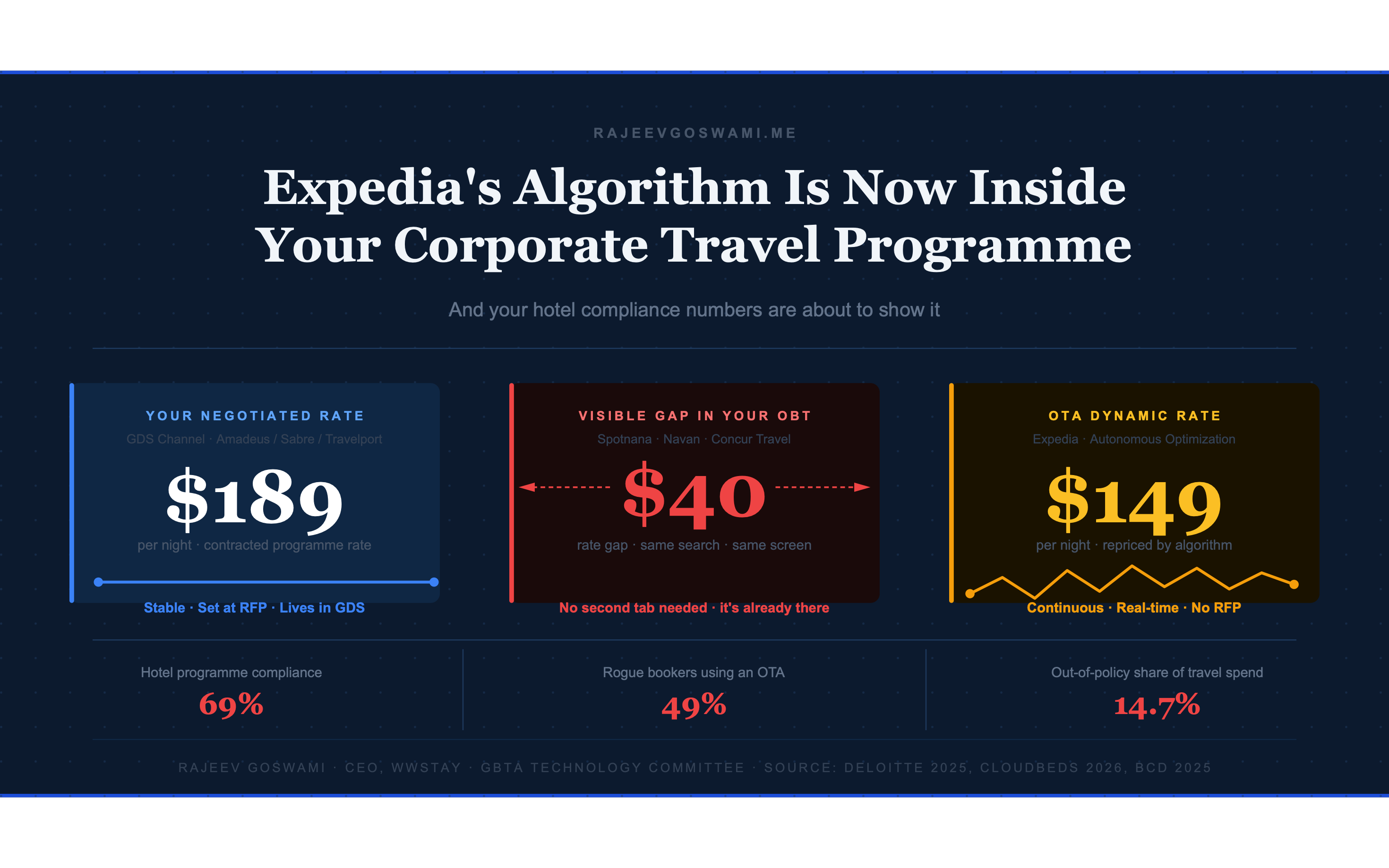
The driver is not traveller carelessness — it is the visible price gap. Deloitte’s 2025 data: 49% of rogue bookers use an OTA to find a cheaper rate and bypass the programme.
What makes Autonomous Distribution directly relevant is where that gap now appears. Modern OBTs — Spotnana, Navan, the new Concur Travel — pull GDS content and OTA feeds, including Expedia, into a single interface. The Expedia-sourced rate sits next to the preferred programme rate in the same search, without opening a second tab. Expedia’s algorithm is not a consumer web problem that policy can wall off. It is already inside your managed travel programme.
When that algorithm reprices hotel inventory continuously for OTA conversion, it widens the gap between the two options more frequently and less predictably. The negotiated rate does not move. The published rate moves around it — and the travel manager absorbs the compliance hit from a variable they cannot see or negotiate with.
The Bigger Risk
Expedia’s likely response: our algorithms optimise public inventory; negotiated rates remain untouched. Technically accurate — and it misses the point. The problem is not that your contracted rate changed. It is that the rate next to it in your OBT got cheaper, faster, and more often.
Your negotiated rates will likely stay in the GDS — but BCD’s 2025 Hotel Industry Report found 18% already fail to load correctly at contract start. Autonomous Distribution adds a continuous dynamic pricing layer on top of a system already leaking.
At renewal, the economics tighten further. With OTAs now commanding 63%+ of independent hotel bookings (Cloudbeds 2026) and Expedia taking 17–19% commission on each, hotels have structurally less margin to offer corporate programme discounts. A revenue algorithm optimised for OTA conversion does not weigh the long-term value of a preferred programme relationship. The compression shows up at RFP time, not on a rate screen.
Hotel compliance is at 69%. The primary leakage driver is the OTA price gap. A system that automates and amplifies that gap is not a hotel distribution story. It is a corporate travel compliance story. The question worth adding to your next hotel RFP: are you enrolled in Expedia’s Autonomous Distribution — and if so, who is actually managing your pricing?
Rajeev Goswami is CEO of WWStay and a member of the GBTA Technology Committee.
Sources
- Expedia’s Autonomous Distribution Asks Hotels to Cede Control — Hospitality.today
- Expedia Group Research: Fully Connected Hotels Improve Revenue Performance — Hotel Online
- American Express Global Business Travel Completes Acquisition of Egencia — Expedia IR
- Unlock Third-Party Content to Elevate Your Hotel Program — Amex GBT
- 2025 Deloitte Corporate Travel Study
- Business Travel Statistics 2026: Compliance & Spend Data — Travel Code
- Inside the Modern Hotel Program — GBTA
- Why Corporate Travelers Keep Booking Around Your Negotiated Rate — Hospitality.today
- Hotels Grapple with Secondary OTAs for Pricing Control — PhocusWire
- Cloudbeds 2026 State of Independent Hotels Report — Hotel Online

Leave a Reply