The compliance question is solved. Your AI booking tool enforces rate caps, flags out-of-policy selections, and triggers pre-approval workflows. The harder question — the one the industry has not started asking yet — is whether the AI making the recommendation can actually see your contracted hotel rate. Hotel GDS rate AI compliance is the new fault line: not whether policy is enforced, but whether the rate that triggers it ever makes the shortlist. Four months ago, I wrote about this content crisis from the hotel’s perspective — how fragmented property data was making hotels invisible to AI recommendation engines. The same crisis is now showing up in corporate travel programmes, from a direction nobody anticipated.
What AI Compliance Tools Actually Do Well
The tools work. Rate cap filters and policy-aware shortlists are standard features in every major OBT platform. Navan, Spotnana, and SAP Concur all enforce rate caps at the point of search or at the API layer. Best-in-class programmes run 90–95% booking-channel compliance — a benchmark cited consistently by OBT providers including Navan and BCD Travel. Travel managers asking whether their AI booking tool enforces policy are asking the right question two years too late.
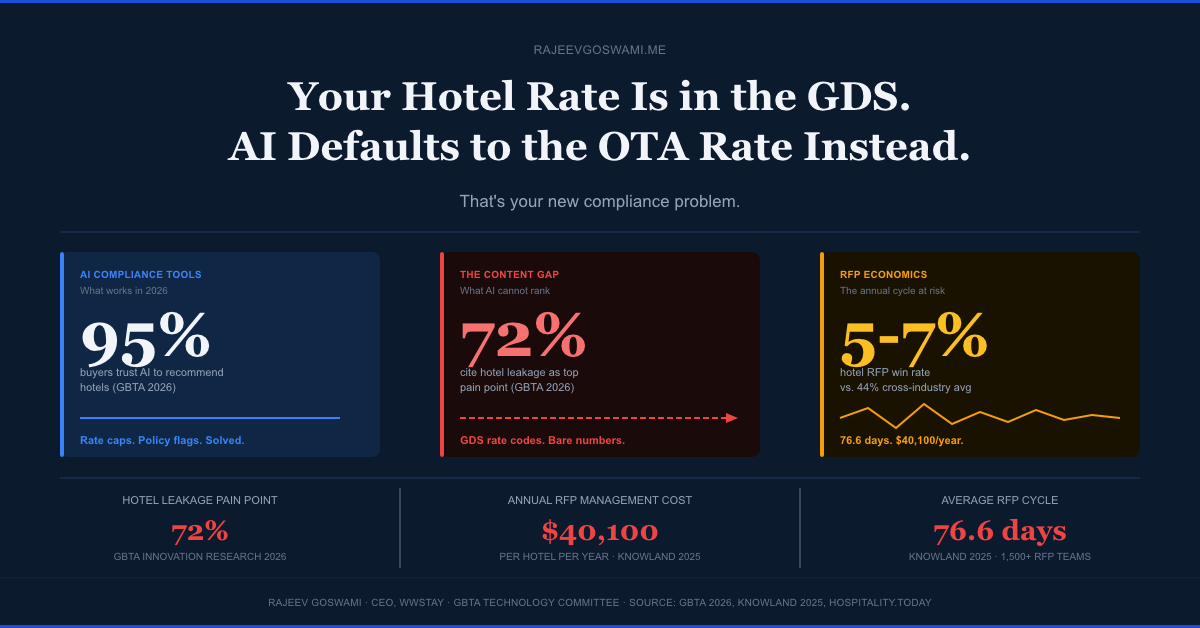
But GBTA’s 2026 Innovation Research tells a different story on hotels specifically: 72% of travel buyers cite their travelers finding cheaper hotel options outside managed channels as their top pain point. Rate caps are enforced. Hotel leakage persists. Something else is breaking.
Why Corporate Travel Managers Need to Ask a Specific Question
GBTA’s same 2026 study reveals a fault line that should make every travel manager reconsider what “AI compliance” actually means. Ninety-five percent of corporate buyers are comfortable with AI recommending hotels based on negotiated rates and preferred suppliers. Only 57% will let it execute a booking change autonomously. That gap is not hesitation — it is an instruction. AI advises. The traveller decides. Which means the recommendation is the transaction. If your contracted rate makes the AI shortlist, it gets booked. If it doesn’t appear there, it does not exist — regardless of what was loaded in your GDS six months ago.
The question worth adding to your next vendor evaluation: is our contracted hotel content structured in a way that AI can read and rank?
Where Contracted Rates Actually Live — and Why AI Cannot See Them
Contracted hotel rates are loaded into the GDS as rate codes. In many cases, they arrive as bare numbers: a price and an availability window, stripped of the inclusions that justify them — flexible cancellation, breakfast, loyalty recognition, duty-of-care metadata. GBTA’s 2026 research found that 51% of buyers say attribute-based shopping would improve the hotel booking experience — because the structured content that enables it rarely travels with GDS rate codes. OTA rates travel differently. They carry amenity tags, cancellation policy flags, location attributes, guest-score data. An AI shortlist engine ranks on what it can read. A contracted rate at $189 with no attributes is structurally disadvantaged against an OTA rate at $199 with breakfast and free cancellation attached — not because the contracted rate is worse, but because the AI cannot confidently construct a preference for it. This is the same entity confidence problem I described in February’s post on AI visibility in hospitality — an AI shortlist engine’s inability to rank what it cannot structurally read. Then the hotel was the victim. Now the travel programme is.
The Content Problem GDS Providers Are Racing to Fix
The GDS providers know this. At HITEC 2026, Amadeus introduced AI Commerce — designed to make hotels bookable inside AI-assistant conversations using its Central Reservation System and GDS infrastructure as the booking rail underneath. Amadeus secured the hospitality seat in Google’s Universal Commerce Protocol, the open standard already deployed with Shopify and Walmart in retail. Sabre is moving in parallel: agentic-ready APIs and an MCP server are live, and a new partnership with BizTrip AI specifically targets corporate travel with policy automation built in.
But the fix is partial. Amadeus’s AI Commerce service had barely a dozen hotel clients at HITEC, the monetisation model is “still not mature,” and full rollout continues through year-end. The GDS is not ceding the pipe. It is recoating it.
Hospitality.today’s framing of the Amadeus play is worth quoting directly: “The pitch to hotels is relief from the intermediaries standing between them and the traveler. The part left unsaid: the relief is another intermediary — the same one, moving to hold the same position in the channel that comes next.”
The Bigger Risk
Travel managers focused on whether AI enforces compliance are solving the right problem and missing the larger one. The real structural question is what happens to the annual hotel RFP while the pipe is being fixed.
According to Knowland research published in 2025 across more than 1,500 RFP teams, hotels win 5–7% of the RFPs they respond to — against a 44% average win rate across every other industry using the process. Hotels spend $40,100 per year managing those responses. The average cycle runs 76.6 days, and 90% of hotels in any programme were already in it the year before. Dan Stagnitta, a travel consultant at Elevance Health, called the annual process “just silliness and busy work.”
Industry signals suggest the calendar is already shifting. ReadyBid, a corporate hotel procurement platform, called 2026 the year of “the complete transition to continuous bidding, where RFPs never truly close” — with rates adjusted dynamically throughout the year rather than reset each autumn.
If Amadeus AI Commerce and Sabre’s agentic APIs deliver, contracted rates will survive — updated dynamically as AI agents query live inventory rather than loaded once into a GDS at the start of the year. The rate relationship persists. The 76-day RFP calendar built for a world of GDS terminals and dropdown OBTs does not.
The most competitive contracted rate is no longer the deepest discount. It is the rate that travels with enough verified facts to make the AI shortlist. The question worth asking before your next cycle launches: does yours?
Rajeev Goswami is CEO of WWStay and a member of the GBTA Technology Committee.
Sources
- Corporate buyers want AI to recommend hotels, not book them — Hospitality.today
- Technology, Managed Travel and Hotel Distribution Gaps — GBTA / Hospitality Net
- Invisible to AI: The Emerging Content Crisis in Hospitality — rajeevgoswami.me
- Amadeus wants to be the middleman AI agents were meant to remove — Hospitality.today
- Amadeus AI Hotel Tools Strategy, HITEC 2026 — Skift
- Beyond the RFP — Why hotels spend $40,000 a year on a 5% win rate — Hospitality.today
- Sabre and BizTrip AI Announce Strategic Partnership — PR Newswire
- Hotel RFP Trends to Watch in 2026: From AI Negotiations to Continuous Bidding — ReadyBid

Leave a Reply