What I keep hearing from many procurement teams, hotel negotiators, and vendor briefings this quarter is the same three words: We’re AI-ready.
In April 2026, The Ascott Limited announced partnerships with Accenture, Amadeus, and EHL to build what it called “AI-ready infrastructure.” Mews had already issued its warning: 2026 is the make-or-break year for hotels to transform or fall permanently behind. The phrase is now in every vendor presentation, every conference keynote, every preferred hotel pitch deck. The problem is that “AI-ready” has a specific, verifiable technical meaning — and most hotels cannot prove they meet it.
What Does “AI-Ready” Actually Means
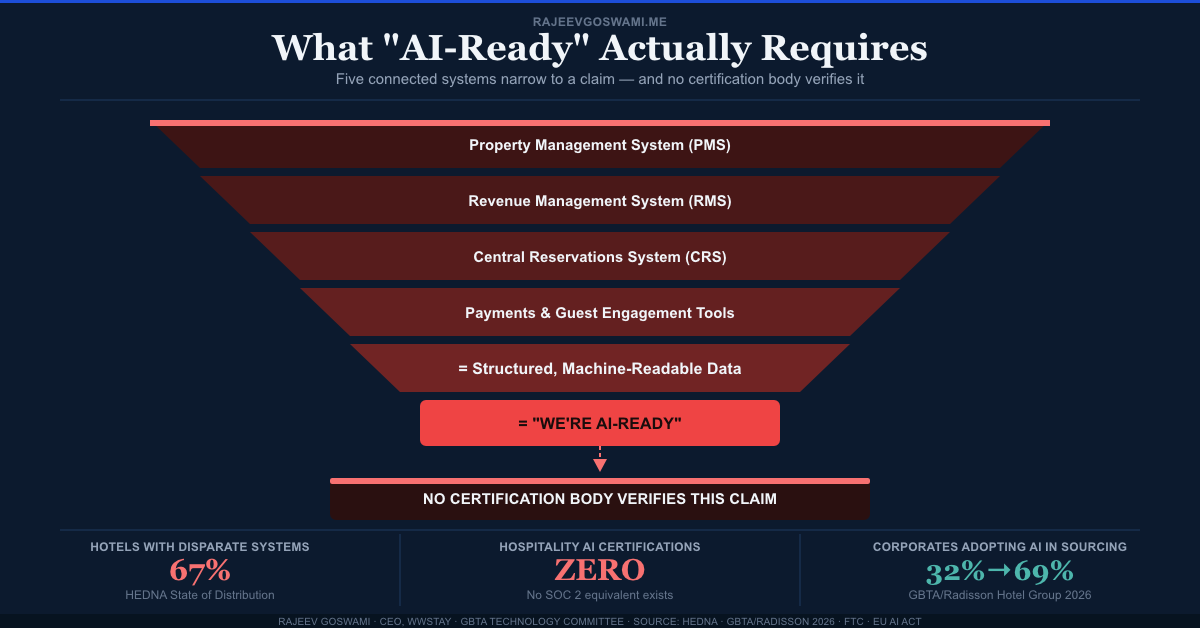
Being AI-ready means something precise: structured, machine-readable data accessible via real-time open APIs across a hotel’s property management system, revenue management system, central reservations, payments platform, and guest engagement tools. Not a chatbot. A connected architecture that allows an external AI agent to read, compare, and book inventory without a human in the loop.
Ascott’s Amadeus partnership gets this right. Implementing the Amadeus Central Reservations System with API-first architecture moves inventory from static content to machine-readable data that AI agents can find and price in real time.
The problem is that 67% of independent hotels cite managing disparate, disconnected systems as their top operational challenge, according to HEDNA’s State of Distribution Report. With that many properties still running disconnected systems, wholesale migration to API-native platforms in the next 12 months is not realistic — yet these are the same hotels now calling themselves AI-ready in corporate client conversations.
Why Corporate Travel Managers Need to Ask a Specific Question
Thirty-two percent of corporate travel programs currently use AI in hotel sourcing. Sixty-nine percent expect to adopt it in the next cycle, according to a GBTA/Radisson Hotel Group study of 258 travel managers published in April 2026. As AI becomes embedded in preferred program evaluation — scoring bids, analyzing rate patterns, flagging compliance — the hotel AI-readiness starts to matter in a way it didn’t two years ago.
But there is no standard question in a hotel RFP to verify the claim. No checklist. No certification body. No audit trail. A hotel with a fully API-connected architecture and one that installed a chatbot last month can both describe themselves as AI-ready. The buyer has no tool to separate them.
The question corporate travel managers should be adding to their preferred hotel RFP now: Which of your core systems expose real-time data via open APIs — and who verifies that independently?
Where the Actual Standard Lives
There is no hospitality AI-readiness certification equivalent to SOC 2, ISO 27001, or PCI-DSS. HTNG has published “AI for Hospitality best practices” and runs a Tech Acceleration Award for hotels implementing them. That is recognition, not certification — no independent audit, no pass/fail threshold. I’ve spent the better part of a year looking for a hospitality equivalent to SOC 2, and I still can’t find one that actually exists.
The de facto standard is being set not by a standards body but by the OTAs. Expedia is launching a B2B agentic AI MCP server in 2026, giving partner AI agents direct access to live inventory. The technical premise is unambiguous: as Hospitality.today noted, an agent cannot book what it cannot parse. Hotels without connected, structured inventory will not appear in the agentic booking layer — not as a deliberate penalty, but because the data pipe does not exist. The OTA dependency that already pressures independent hotel margins will tighten further as chain hotels pull ahead in AI-mediated distribution.
The Compliance Problem the Claim Is About to Make Worse
The regulatory environment is catching up, but not in the direction most hotel marketers expect. The FTC filed its thirteenth AI-washing enforcement case in May 2026, against Cox Media Group and two marketing firms that claimed an AI “Active Listening” capability that did not exist — sold to business clients. Of the FTC’s last eight AI-washing cases, seven involved B2B marketing claims. The enforcement trend is toward B2B, not consumer, contexts.
In Europe, the picture is more specific. Hotels operating AI-powered dynamic pricing or guest profiling in EU markets are within scope of the EU AI Act. Transparency and disclosure requirements take effect August 2026; the full audit-trail and human oversight obligations were deferred to December 2027 under the Digital Omnibus agreed in May 2026 — but the compliance architecture must be built now for a deadline 18 months away. California’s Governor Newsom signed Executive Order N-5-26 in March 2026, establishing AI vendor certification requirements for state contractors. Government-mandated AI certification is no longer hypothetical.
The Bigger Risk — My Take
The dynamic is not new. Hospitality spent years with “sustainable” on every website before the EU’s Empowering Consumers Directive required substantiated environmental claims — generic self-declarations no longer sufficient. The same pattern is forming around AI. The companies loudest about hotel AI-readiness are often selling the solution to achieve it — Mews, Amadeus, and Oracle define what readiness means and profit when hotels buy their platforms to get there.
The corporate travel manager’s problem is not that hotels are claiming AI-readiness. It is that preferred hotel programmes are about to be built on unverified claims, and the accountability gap will only close when a standards body builds the certification or a regulatory mandate forces disclosure. A preferred hotel that cannot deliver real-time, structured data will silently degrade your programme’s AI-assisted compliance tracking, rate reporting, and duty-of-care monitoring — the exact outcomes AI adoption was supposed to improve.
GBTA or HTNG could build this. A practical AI-readiness checklist for hotel RFPs — five independently verifiable questions — would be more useful to procurement teams right now than another panel on AI transformation.
I think whichever body moves first on this — GBTA, HTNG, or a regulator — will end up setting the de facto hospitality AI standard for the rest of the decade, and buyers should be pushing for it now rather than waiting for it to be handed to them.
Until then: If you’re AI-ready, name the systems with real-time API access — and the certification that verifies the claim.
Rajeev Goswami is CEO of WWStay and a member of the GBTA Technology Committee.
Sources
- AI Tipping Point: Mews Warns 2026 Is Make-or-Break Year — PR Newswire
- Ascott Invests in AI-Ready Infrastructure — Hospitality Net
- Six Forces Reshaping Independent Hotels 2026 — Hospitality Net
- Corporate Hotel Programs Evolve Amid AI — GBTA/Hospitality Net
- Machine-Readable Supply Is the Agentic Booking Condition — Hospitality.today
- Expedia Agentic AI B2B Server Launches in Months — Nomad Lawyer
- FTC AI-Washing Enforcement in B2B Context — DLA Piper
- FTC Brings Dozen AI-Washing Cases — National Law Review
- EU Moves to Tighten AI Regulation for Hotels — Hotel News Resource
- Newsom Signs EO N-5-26 on AI Certification — Ropes & Gray

Leave a Reply